
Critical Trial: Every Click. Every Post. Every Risk
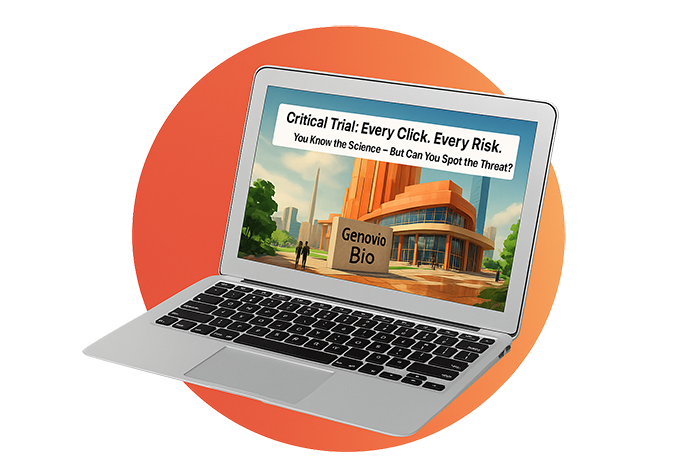
I designed this scenario-based eLearning concept project for newly hired biopharmaceutical research scientists who handle sensitive patient information and proprietary research in their daily work.
- Audience: Newly hired Research Scientists, Clinical trial staff and Data Specialists
- Responsibilities: Needs Analysis, SME interviews, Data collection and analysis, Instructional Design, eLearning Development, Script writing, Storyboarding, Visual Design, Action Mapping, Prototyping
- Tools Used: Articulate Storyline 360, Freepik AI, Adobe Photoshop, Canva, MindMeister, Milanote, Google Suite
The Problem
Secure data underpins regulatory approval, patient safety, and scientific credibility in the Biopharma Industry. Even minor lapses can cause costly trial delays, regulatory investigations, and loss of trust.
Detailed conversations about cybersecurity with biopharma research scientists (SMEs) indicated a recurring gap between compliance knowledge and real-world decisions. SME interview analysis showed that research scientists were vulnerable to a variety of sophisticated cyberthreats. Improving data integrity training thus became essential not just for compliance, but to protect companies’ reputation, and to deliver life-saving therapies to the society at large.
This concept project addresses the need to strengthen staff training on data integrity in GenoviaBio, a fictitious global biopharmaceutical company representing big pharma companies in clinical trials.
Proposed Learning Solution
After identifying the problem through extensive interviews, data showed that traditional compliance training were checklist-driven and did not reflect data-related situations staff face in daily work.
I evaluated several options like microlearning, interactive job aids, case-study workshops and gamified quizzes. While the options are efficient for concept delivery, they are either too passive for a learner to build judgement (microlearning for example) or hard to scale consistently across sites (case-studies for example). Interactive job aids and gamified quizzes are reactive rather than preventive. They add engagement, but lack real-world context necessary for an immersive experience that carries emotional realism.
Based on this reasoning, I proposed a scenario-based, story-driven learning that creates a safe space for research scientists to practice decision-making without real-world consequences.
Learners are placed in realistic situations – such as reacting to a phishing email, deciding whether to post a lab image, or securing an unattended device – and immediately see the outcomes of their choices. This safe, immersive environment allows them to build judgment, strengthen data integrity habits, and experience how small actions can lead to major impacts.

My Process
To design this solution, I followed the ADDIE model, adding key design tools at each stage to ensure the project was realistic, engaging, and instructionally sound.
Analysis – I partnered with a subject matter expert to uncover gaps between compliance knowledge and real-world decision-making, reviewed past data integrity incidents, and mapped learner needs.
Design – I created an action map to link training objectives directly to on-the-job behaviors and built a text-based storyboard as the project blueprint, outlining scenarios, dialogue, branching choices, and consequences.
Development – I designed the visual look and feel using a mix of artist-created and AI-generated images to bring the GenoviaBio world to life. Then I developed the full project in Articulate Storyline, layering in animations, character interactions, and programmed interactivity.
Implementation – I piloted the project with a small group of research staff to test usability, clarity, and engagement.
Evaluation – I gathered learner feedback, tracked responses to decision points, and refined the storylines and feedback mechanisms with SME input.
This structured process ensured the final product was anchored in real-world challenges, visually engaging, and offered a safe, interactive space for learners to practice decision-making.
Action Map
To sharpen the focus of this project, I built an action map in collaboration with a Biopharmaceutical subject matter expert. Together, we identified the critical high-priority actions employees must perform to protect data integrity in their daily work. Instead of building a course around “what people need to know”, I focused on “what people need to do” in real conditions.
The process surfaced three critical high-priority action areas:
- Responding appropriately to suspicious emails.
- Recognizing the risks of sharing lab-related content on social media.
- Securing sensitive data devices in shared environments.
By mapping these actions against potential obstacles and decision points, the action map became a blueprint for behavior change. It guided the scenarios, ensuring every choice in the training was tied to decisions in the real-world rather than abstract knowledge.

Text-based Storyboard
Following the ADDIE model, once the analysis and action mapping were complete, I created a text-based storyboard as the blueprint for the project. This storyboard detailed the story arc, characters, learner choices, and the consequences of each decision, ensuring alignment with the high-priority actions identified earlier. The narrative was written to immerse learners in realistic situations, showing not only what to do but also what happens when mistakes are made.
To support learners, I introduced a mentor character who appeared in the experience as a guide. Acting like a just-in-time job aid, the mentor provided optional tips and context without revealing the correct answer, allowing learners to remain responsible for their own decisions.
I grounded the design in Gagné’s Nine Events of Instruction, ensuring attention was captured, objectives were clarified, scenarios presented, guidance was available, and immediate feedback was provided.
This combination of ADDIE’s structured design process and Gagné’s instructional events helped me create a storyboard that was both theory-driven and practical, bridging the gap between compliance knowledge and real-world behavior.
Each question was based on the action that we wanted people to practice, and I made sure to embed each question within the real-world context.


When users choose the correct action, they see a positive consequence and continue the scenario. Incorrect choices trigger realistic negative outcomes of varying severity, followed by a chance to try again. A mentor button offers optional guidance, letting users pull information only when needed.
Storyboarding enabled me to craft an authentic, consequence-driven experience that immerses users and strengthens learning and retention.
Visual Mockups
With the storyboard in place, I moved into the visual design phase. Next, I developed a style guide in Canva to ensure consistency across the project, covering layout, fonts, color palette, and character treatments.
I then iterated on the high-fidelity slide mockups to test layouts for scenario slides, consequence reveals, and mentor interactions. For assets, I blended AI-generated images with designer-created visuals. Using prompt engineering techniques, I refined AI image outputs to achieve consistent characters, professional lab settings, and a cohesive visual style further refining them using Canva, PowerPoint, and Adobe Photoshop.
Throughout this phase, I shared drafts and received valuable feedback on clarity, visual hierarchy, and learner navigation. The feedback I received and implemented on the mockups helped ensure the best user experience possible before moving into development.
To maintain realistic-aesthetics throughout the project, I designed the email mockup on a desktop, internal communication tool mockup on a laptop and social-media mockup on a mobile phone device as well.


Interactive Prototype
Before full development, I built an interactive prototype to test functionality and collect early feedback. Using Articulate Storyline, I created several interactive slides, including navigation elements, mentor interactions, and the first scenario-based question. This prototype allowed stakeholders to experience the look, feel, and flow of the course in action, rather than relying only on static mockups.
In the interactive prototype I programmed through the first question and stopped at that, to collect feedback at this stage. This is mainly to ensure that everything looked and worked as expected. The iterative approach ensured that all changes based on the feedback were incorporated at this stage rather than having to make changes in the final product. The goal with this step was to ensure that the final products would not only look polished but also speed up the development process.
Full Development
After collecting and applying feedback from the prototype, I developed the final product in Articulate Storyline. This stage brought together all elements – animations, branching interactivity, polished visuals, and refined mentor guidance – to create a seamless scenario-based experience. Every slide was designed to feel realistic, with smooth transitions, consistent branding, and engaging feedback for each learner decision.
Unique features included:
- Branching consequence paths, where each learner choice triggered immediate, story-driven outcomes.
- An on-demand mentor character, offering optional guidance without breaking immersion.
- Dynamic animations and slide transitions that reinforced urgency in high-stakes scenarios.
I applied Mayer’s Multimedia Principles to balance text, visuals, and audio cues; Adult Learning Theory to ground each scenario in real-world relevance; and Constructivist design to let learners learn by doing, not just reading. This combination ensured the project was not only visually polished but also maximized engagement, retention, and transfer of learning into daily practice at GenoviaBio.
Results & Takeaways
Although GenoviaBio is a fictional client, I tested the final project with a small group of research scientist SMEs to validate realism and instructional effectiveness. The SMEs noted that the branching storylines and immediate consequences felt “authentic to the pressures of real lab work” and that the mentor character provided just-in-time guidance without interrupting the learner’s decision-making flow.
“This compliance training feels like it understands what we actually face in the lab. It doesn’t just tell us what to do—it shows us what happens if you don’t.”
“The scenarios really captured the gray areas we deal with every day. I appreciated that the project didn’t just mark answers right or wrong but showed the ripple effect of each choice. That’s exactly how it happens in real research—one small slip can snowball into a big issue.”
Feedbacks like these reinforced that the project successfully bridged the gap between abstract policy and real-world action.
‘The impact of the project was clear: learners showed greater confidence in handling phishing attempts, social media risks, and device security. The safe, story-driven environment helped participants internalize data integrity as part of daily work, not just as a policy requirement.
Key Takeaways:
- Scenario-based design creates a safe practice space for high-stakes decisions.
- Involving SMEs early and throughout ensures authenticity and credibility.
- Learners value training that is immersive, realistic, and directly tied to their work.
Next steps would include expanding the concept project with additional scenarios (e.g., remote collaboration, partner data sharing) and embedding it in a broader onboarding program for new research staff.
Let's Connect
If you’re looking for someone who can turn complex concepts into clear, impactful learning — on time and on brand, let’s connect.