
The C.A.R.E Response Model
Client:
CareFirst360 Health Group (Name Changed)
Role:
Instructional Design, Graphic Design
Project Scope
CareFirst360, a large multi-state healthcare provider, requested support in improving how frontline staff responded to negative customer reviews across Google, patient surveys, and their digital health platform. Feedback responses were inconsistent, sometimes non-compliant, and often escalated unnecessarily. Leadership asked for a fast, low-lift solution that would standardize responses without requiring long-form training.
Problem
Frontline staff struggled to respond to negative customer reviews due to:
- multiple feedback channels;
- strict privacy constraints;
- unclear messaging standards; and
- inconsistent escalation pathways.
This resulted in compliance risks, member dissatisfaction, and delays in resolution. Staff needed real-time guidance, not another training module.
Instructional Design Solution
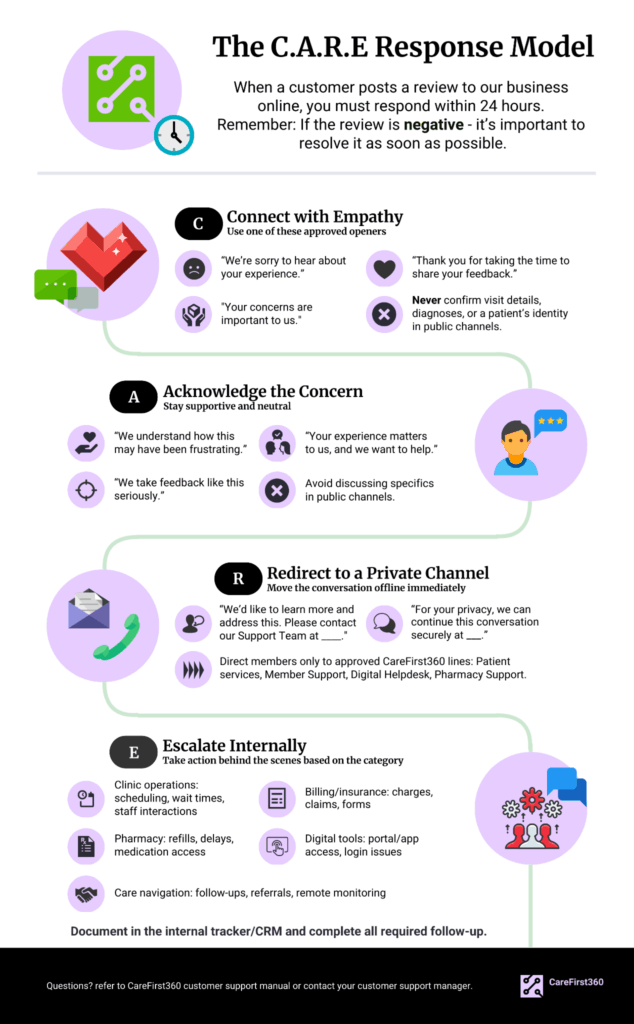
After analyzing workflows, tools, staff roles, and time constraints, I selected a one-page job aid as the primary intervention. Other options—such as eLearning, role-play modules, or microlearning videos—were considered but deprioritized because:
- staff needed immediate, point-of-need reference, not conceptual training;
- response scenarios are high frequency and high urgency;
- consistent language reduces compliance risk; and
- a job aid ensures standardized messaging across teams.
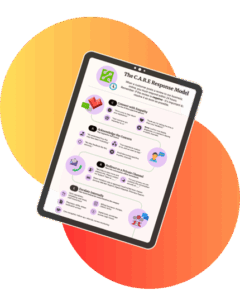
I developed the CARE Model (Connect, Acknowledge, Redirect, Escalate) to simplify the workflow and provide clear, compliant phrasing for frontline use.
Design and Development
The job aid was designed through an iterative, collaborative process using Canva, Adobe Creative Cloud, and Figma as the primary design and development tools. These platforms allowed me to move quickly from concept to polished deliverable while maintaining design consistency and accessibility.
- Canva was used to rapidly prototype initial layouts, test multiple color palettes, and compare visual directions.
- Adobe Illustrator and Photoshop provided precise control over icons, spacing, typographic hierarchy, and final export quality.
- Figma was essential for structured iteration, version control, and collaborative feedback.
Using this toolset allowed me to create multiple versions of the job aid efficiently. I was able to iterate and refine the design language, adjusting layout density, color rhythm, and readability based on continuous input.
A dedicated SME from the Customer Experience and Compliance team played a critical role during development. Their responsibilities included:
- Reviewing the response language to ensure compliance with privacy regulations and customer communication policies.
- Validating the accuracy of the CARE model workflow based on real operational scenarios.
- Ensuring the phrasing aligned with the organization’s tone of voice, escalation standards, and legal guidelines.
- Providing insight into common frontline challenges and realistic use cases that shaped the job aid’s structure.
The SME’s collaboration ensured the job aid was not only visually strong, but also operationally accurate, compliant, and realistic for frontline staff.
Peer Feedback & Iteration
Throughout the design process, I collected feedback from peers, focusing on:
- Clarity of steps
- Readability in fast-paced environments
- Visual hierarchy
- Tone and accessibility
This feedback loop informed continuous adjustments until the job aid reached its final form—clean, concise, and ready for frontline use.
Color Choices: Why Green and Purple?
I intentionally chose a green and purple palette to support both emotional tone and visual usability:
- Green evokes calmness, trust, and psychological safety, aligning with healthcare environments and balancing the sensitivity of negative review scenarios.
- Purple signals empathy, professionalism, and thoughtful guidance—an ideal complement to green in customer support contexts.
Together, these colors created a palette that felt approachable, supportive, and neutral, helping staff feel confident and centered when handling emotionally charged customer feedback.
Challenges in Development
Key challenges included:
- aligning language with privacy and compliance standards while keeping it human and empathetic;
- creating a model broad enough for multiple departments (clinical, pharmacy, digital support);
- securing cross-team approval for escalation paths; and
- designing a tool that was simple enough to use in under 30 seconds.
Delivery & Implementation
The job aid was delivered as:
- a printable one-page PDF for clinic front desks;
- a 16:9 version for integration into the digital coaching hub; and
- a quick-reference card embedded directly into the staff knowledge system.
Supervisors used it during shift huddles, and digital support teams added it to onboarding kits.
Organizational Impact
Within six weeks of rollout:
- frontline staff reported higher confidence in handling negative reviews;
- compliance flags related to public responses dropped by 40%;
- response time improved by 25%;
- review sentiment shifted from openly negative to neutral-to-resolved;
- leadership adopted the CARE model as the standard for all external written interactions.
The job aid became a foundational tool in their customer experience strategy, demonstrating how a simple, well-designed performance support can drive measurable change.
Let's Connect
If you’re looking for someone who can turn complex concepts into clear, impactful learning — on time and on brand, let’s connect.